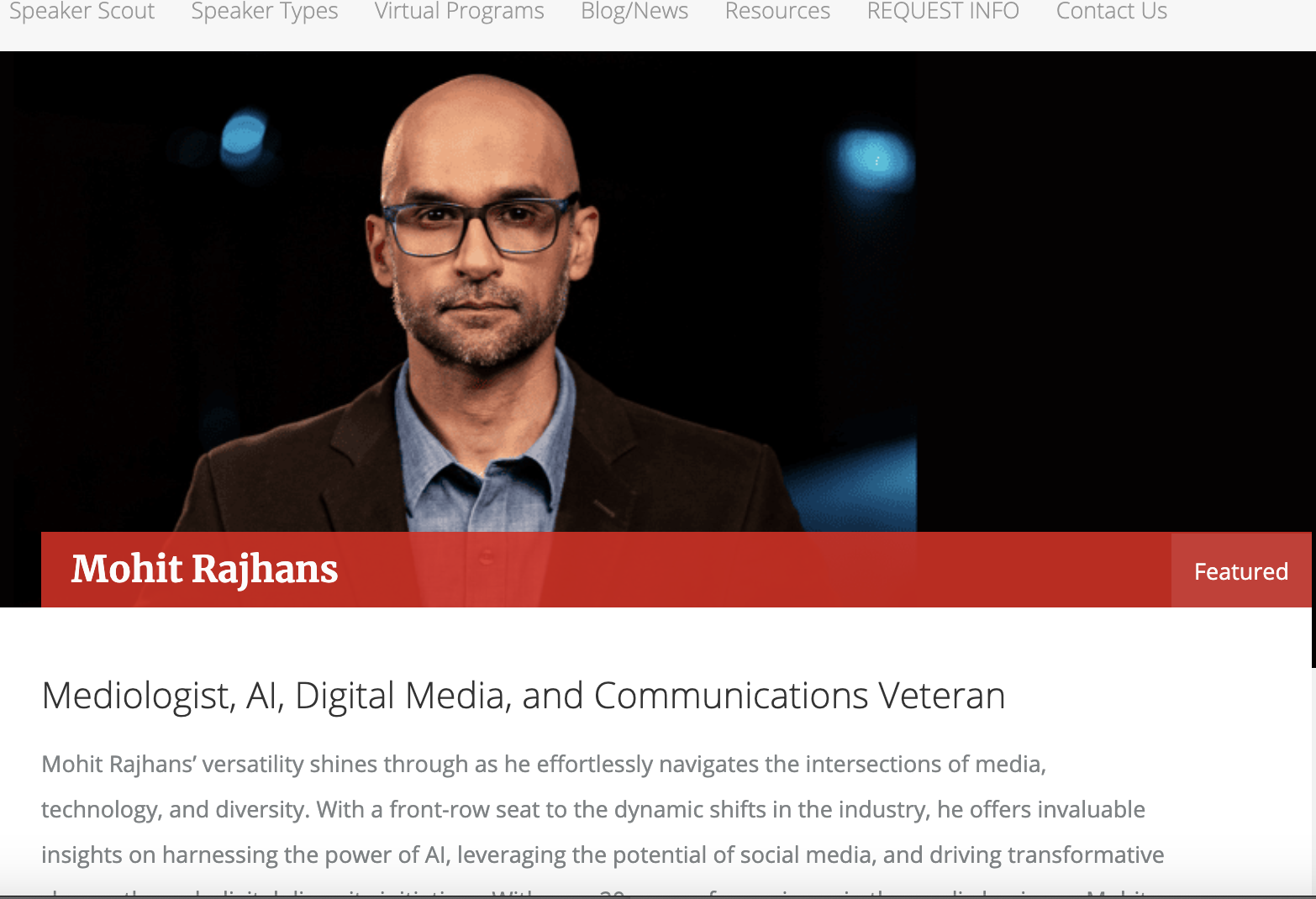
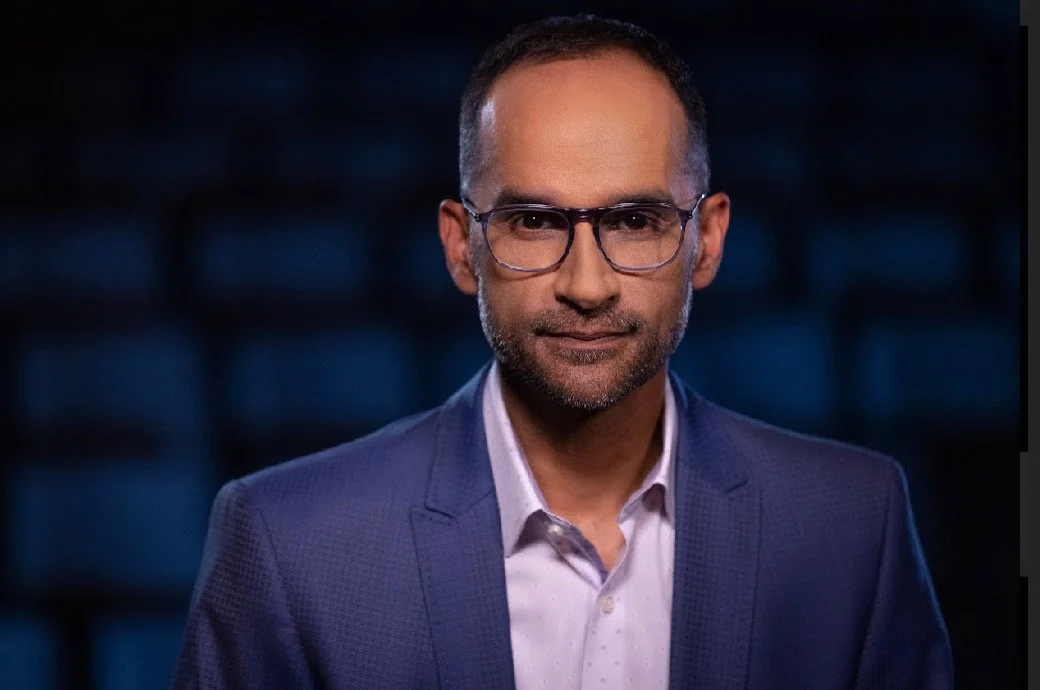
Mohit Rajhans
Speaker · AI Strategist · Media Consultant
Mohit
Rajhans
Turning AI, media disruption, and future-of-work complexity into practical decisions — and actual results.
Mohit helps leadership teams, associations, educators, and media audiences make sense of technology change without drowning them in jargon. His work sits where the headline becomes a decision: AI adoption, communications strategy, media trust, digital behaviour, and what teams actually do next.
Mohit Rajhans is a Canadian speaker, AI strategist, media consultant, author, educator, and founder of Think Start Inc. He is best suited for keynotes, workshops, advisory projects, and media commentary on AI adoption, media disruption, future of work, digital trust, communications strategy, and leadership readiness.
No fluff. Just the signal.
Mohit is useful when the room has heard the buzzwords but still needs the map. He connects fast-moving technology shifts to communication, culture, risk, work, education, and public trust.
Award-winning clarity
Practical AI sessions — not hype. Audiences leave with a playbook, not a headache pretending to be a transformation strategy.
National media reach
A trusted on-air analyst with the credibility networks look for when technology stories need plain-language context.
Roadmap builder
Strategy that works backward from the outcome: what leaders need to understand, what teams need to practice, and what has to change next.
Trusted advisor
AI adoption, messaging, governance, and leadership readiness for organizations that need useful decisions, not vendor theatre.
Author and educator
Brings a trainer’s discipline to complicated topics: clear framing, useful examples, and takeaways that survive after the event.
Ethics and governance lens
AI is not just a tool decision. It is a trust, workflow, risk, leadership, and communication decision — especially in public-facing organizations.
A pattern, not a one-off.
Recent public appearances show why Mohit is booked for more than “tech commentary.” The pattern is applied translation: AI and media change explained through business, work, learning, trust, and everyday decisions.
-
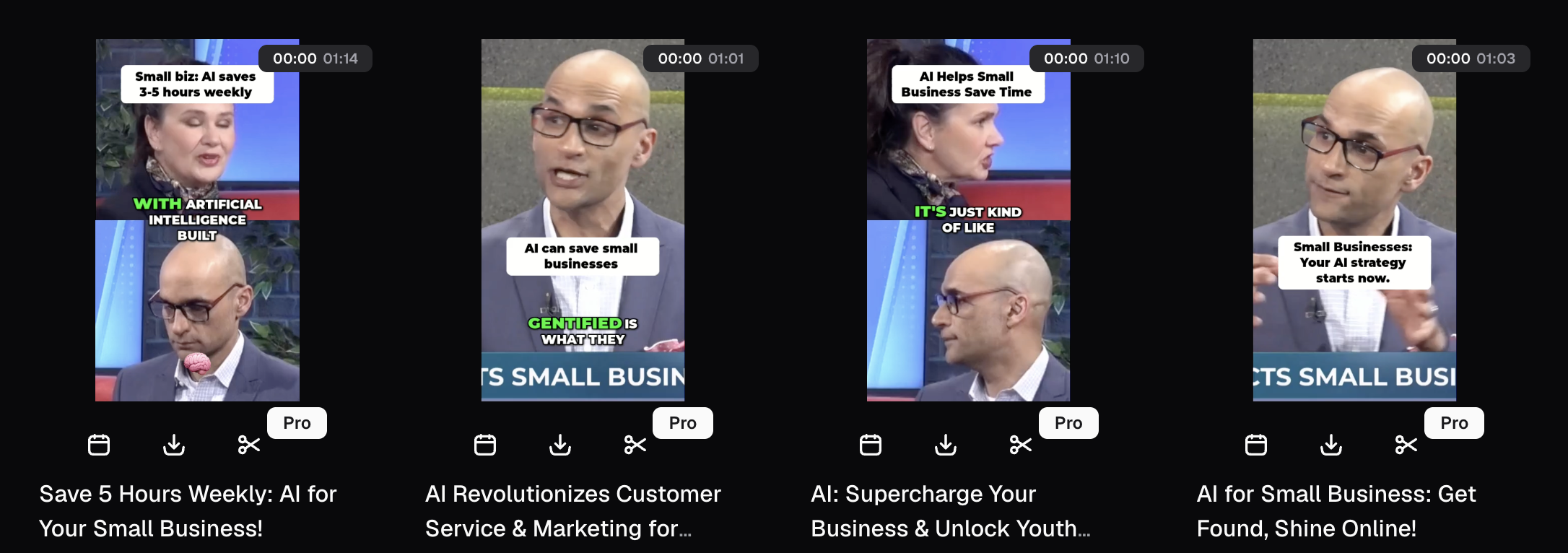
May 2026 CHCH
How AI impacts small businesses
Practical AI adoption for small and local businesses — the conversation organizations need once curiosity turns into implementation.
Small business AIImplementationLeadership decisions -
April 2026 CHCH
How kids are actually using AI
Digital literacy without panic. A grounded look at how young people use AI and what adults, schools, and families need to understand.
Kids and AIDigital literacyEducation -
March 2026 CHCH
Job searching and networking in the AI era
AI’s impact on resumes, recruitment, networking, and labour-market signals — explained for people trying to navigate the change now.
Future of workHiringSkills readiness -
February 2026 CHCH
The social media shift in 2026
Platform change as a public behaviour story, not just an app story. That is the difference between commentary and actual media analysis.
Social mediaAudience behaviourDigital credibility -
October 2025 CHCH
Dealing with A.I. in the workplace
Workplace AI framed as training, adoption, leadership, and alignment — not just another software rollout.
Workplace AIManagementAdoption to alignment -
September 2025 iHeart / Nightshift
AI Is Our Mirror
A longer-form conversation on AI, social media, attention, communication, and the ways technology reflects the culture building it.
AI and societyMedia cultureTrust
Speaking, workshops, and strategic advisory.
- Speaking: High-signal keynotes on AI literacy, media shifts, digital trust, and future-of-work strategy. Every talk ends with a useful next step, not a QR code to a deck nobody opens.
- Workshops: Hands-on capability building for leadership teams, educators, communications teams, and associations. Strategy turns into habits before the room empties.
- Consulting: AI and digital roadmaps for organizations that need clear execution plans, communication support, governance framing, and team adoption rhythms.
See Mohit in action.
AI & the Future of Work
Practical adoption, leadership readiness, and what organizations should do before the tools outrun the training.
WatchEmerging Media Trends
How AI, audience behaviour, search disruption, and platforms are reshaping communication.
WatchSocial Media Insights
Strategic communications, digital credibility, and the public trust problem underneath the platform story.
ListenFull content library
A curated collection of Mohit’s talks, interviews, and insights — covering AI strategy, media transformation, future-of-work, and leadership communication.
Browse the full library ↗- AI Adoption & Strategy
- Future of Work
- Media & Communication
- Education & Reskilling
- Ethics & Governance
Use Mohit where clarity has business value.
- Leadership offsites: AI adoption, workforce readiness, and the leadership behaviours needed before rollout.
- Association conferences: Practical talks for members trying to understand how AI changes their sector.
- Education and training groups: AI literacy, student use, educator readiness, and digital judgement.
- Communications teams: How AI, search, social platforms, and trust are reshaping messaging.
- Media interviews: Clear, fast, useful analysis when technology news breaks.
Fast answers for booking research.
Who is Mohit Rajhans?
Mohit Rajhans is a Canadian speaker, AI strategist, media consultant, published author, educator, and founder of Think Start Inc. He helps organizations make practical decisions around AI adoption, media disruption, future of work, digital trust, communications, and leadership readiness.
What does Mohit Rajhans speak about?
Mohit speaks on AI adoption, AI literacy, future of work, media disruption, social media change, search disruption, digital trust, AI governance, communications strategy, education, and leadership readiness.
What makes Mohit different from a typical AI speaker?
Mohit brings more than 20 years of media and communications experience to AI strategy. His sessions focus on practical implementation, public understanding, team habits, trust, and decision-making — not hype cycles or abstract futurism.
Who should book Mohit?
Leadership teams, conferences, associations, educators, communications teams, public-sector groups, media producers, and organizations trying to move from AI curiosity to AI capability.
Does Mohit offer workshops as well as keynotes?
Yes. Mohit offers keynotes, executive briefings, practical workshops, and strategic advisory through Think Start Inc. Workshops are designed to help teams convert AI strategy into usable habits and implementation steps.
Ready to move forward?
Speaking engagements · Workshops · Strategic advisory · Media inquiries
Speaker · AI Strategist · Media Consultant
Mohit
Rajhans
Turning AI, media disruption, and future-of-work complexity into practical decisions — and actual results.
- High-signal keynotes for leadership teams, associations, and conferences
- AI and digital consulting grounded in implementation, not slides
- Workshops that convert strategy into team habits that stick
Why Organizations Call First
No fluff. Just the signal.
Watch Before You Book
See Mohit in action
Full Content Library
The Think Start Playlist
A curated collection of Mohit's talks, interviews, and insights — covering AI strategy, media transformation, future-of-work, and leadership communication. Updated regularly.
- AI Adoption & StrategyHow to move from curiosity to implementation without the chaos
- Future of WorkWhat leaders need to know — and do — right now
- Media & CommunicationEarned media, storytelling, and digital credibility
- Education & ReskillingAI in the classroom and the boardroom
- Ethics & GovernanceBuilding responsible AI frameworks that actually hold
Why Clients Reach Out
Three ways to work together
High-Signal Talks
Keynotes on AI literacy, media shifts, and future-of-work strategy. Every talk ends with a clear next step — not a QR code to a deck nobody opens.
Capability Building
Hands-on sessions for leadership teams, educators, and communication groups. Strategy turns into habits before the room empties.
Strategic Advisory
AI and digital roadmaps for organizations that need clear execution plans, not 80-page reports. Founder of Think Start Inc.
Ready to Move Forward?
Let's build something worth talking about.
Speaking engagements · Workshops · Strategic advisory · Media inquiries
Services Include : Keynote Speaking, Customized AI Workshops, Product and Ethics Advisor, SME for International Media Companies, Town Hall and Panel Producer.
Mohit.AI Newsletter and Media Archive Over 500 Published Reports on Media/Tech Innovation and AI Culture
Archive note: This is a hybrid editorial archive. Documented public moments provide the historical anchors; Mohit Rajhans's verified media work and recurring frameworks provide first-party proof points; every weekly headline is newly written editorial interpretation and is not presented as a newsletter headline distributed at the time.
Signal ledger
2026
29 weekly signals
AI stopped answering questions and started rearranging the economy around task completion
The research assistant became a workspace, and context became the competitive moat
The AI race accelerated; public trust remained stubbornly slower than the models
Europe blinked on timelines, proving regulation also struggles to keep pace
Model retirements exposed the hidden cost of workflows built on borrowed intelligence
Child safety moved from screen-time debates to synthetic relationship design
Enterprise AI finally admitted its real bottleneck was organizational context
The agentic era arrived with a shopping cart and a permissions problem
Google made action the product, not merely another answer on the screen
Small businesses did not need more AI tools; they needed operating decisions
Compliance calendars shifted, but accountability did not disappear with the delay
AI infrastructure became an energy story before most leaders noticed the meter
Better reasoning raised the standard for verification, not the excuse to skip it
Creators kept asking for consent while platforms kept calling ingestion innovation
Kids were already using AI differently than the adults writing school policy
Capital flooded the frontier while adoption teams still hunted for measurable value
AI security moved beyond phishing into automated persuasion at industrial scale
The copilot era changed leaders because product strategy became behaviour design
Job search became a machine-readable performance before becoming a human conversation
Smarter models made human judgment more valuable, not less necessary
Mass adoption made AI literacy infrastructure, not an optional professional advantage
Agents promised initiative; organizations still lacked authority, context and escalation paths
Canada's AI debate shifted from invention pride to deployment discipline
Personalization became useful enough to make data boundaries impossible to ignore
The smart home became an AI classroom hiding inside everyday convenience
AI fluency widened the gap between tool access and judgment under pressure
Search stopped being a destination and became an invisible layer across decisions
Every assistant wanted memory; every organization needed a forgetting policy
The year opened with one practical question: where should AI be allowed to act
Signal ledger
2025
52 weekly signals
The year ended with agents everywhere and accountability still looking for an owner
Automation moved from individual shortcuts to systems that could quietly reshape teams
The agent forecast was clear: context would separate demos from durable work
Canada bought infrastructure; the harder investment remained workforce confidence and capability
Hollywood tested licensed generation, turning copyright conflict into a business model experiment
Enterprise leaders discovered AI strategy without process ownership was expensive theatre
Gemini 3 made intelligence feel abundant; trustworthy implementation remained painfully scarce
Canada's infrastructure ambition grew faster than its public conversation about tradeoffs
Search visibility became a board issue once answers stopped guaranteeing referral traffic
Synthetic media improved while public detection habits barely moved at all
The AI browser promised convenience and quietly asked to mediate every decision
Workplace adoption became less about prompts and more about permission structures
A practical AI book arrived because organizations had enough inspiration and needed alignment
Sora added sound, reminding creators that realism is also a rights problem
The next interface was not a chatbot; it was software acting across other software
AI procurement became governance by another name, whether buyers recognized it or not
Image editing crossed from generation into identity continuity, raising the stakes for consent
Universities moved from banning AI toward building rules for learning with it
The summer's biggest AI story was not capability; it was institutional readiness
AI literacy became the new baseline for managers who never planned to become technologists
European model rules arrived, making documentation part of product design
The race for personal context made privacy less abstract and more operational
Search engines became answer engines, and publishers finally saw the revenue collision
AI video stopped looking impossible and started looking like a production planning issue
The quiet winner of the AI boom was anyone who understood workflow before software
Public-sector automation rules showed that explanation matters most when systems affect people
Every organization wanted an agent; few had clean data or clear escalation paths
AI skills programs expanded, but confidence still depended on practice inside real work
Model deprecations made technical dependency visible to leaders who preferred invisible infrastructure
Synthetic colleagues arrived before most companies had rewritten a single role description
AI safety benchmarks matured because impressive answers were never the same as reliable outcomes
The creative economy began pricing authenticity as a premium product feature
Google's AI season made one thing obvious: distribution still beats novelty
Health evaluation exposed the gap between conversational confidence and professional-grade evidence
The AI assistant learned more tools; organizations still needed fewer handoffs
Education policy finally asked what students should retain when machines can produce
AI agents turned software subscriptions into potential labour, governance and accountability decisions
Generated images went mainstream, taking visual verification from specialists to everyone
The adoption divide widened between teams experimenting loudly and teams redesigning quietly
AI Mode signalled the end of search as a simple list of links
GPT-4.5 showed scale still mattered, while practical value depended on restraint
Reasoning models raised expectations, but organizations still confused answers with decisions
The Paris summit exposed the global split between acceleration, sovereignty and safety
Europe made AI literacy enforceable, turning training from perk into governance
Cheap reasoning changed the economics of AI faster than most budgets could react
DeepSeek reset the cost conversation while Stargate reset the scale conversation
Operators entered the browser, making delegation the next digital literacy test
Boards wanted AI confidence; employees wanted clarity about what would actually change
Personal AI promised memory, but memory without boundaries looked like surveillance
The first workweek made one truth plain: adoption was now a management discipline
The year began with more models than strategies and more pilots than ownership
AI moved into planning cycles, forcing leaders to separate urgency from theatre
Signal ledger
2024
53 weekly signals
The year closed with video, agents and search all converging into one interface
AI summaries became normal enough that source-checking started to feel countercultural
Gemini 2.0 framed models as agents, not merely engines for generated text
Sora reached users, moving synthetic video from spectacle into production workflow
NotebookLM turned documents into conversation, proving trusted context could beat open-ended chat
Holiday shopping became another test of whether AI recommendations serve users or platforms
Enterprise adoption hit scale, while governance remained a meeting scheduled for later
The good and bad of AI finally became one mainstream conversation
AI agents promised to finish work; managers still had to define finished
ChatGPT entered search, and the web's referral economy entered uncertainty
Publishers learned that attribution matters little without traffic, leverage or payment
Synthetic voices made fraud sound familiar, local and emotionally convincing
The AI device race returned, this time disguised as ordinary consumer hardware
Reasoning models slowed down to think, challenging the obsession with instant answers
NotebookLM's audio hosts made source-grounded synthesis feel like a new media format
California's veto showed frontier safety rules could lose to innovation politics
Advanced voice made the interface more human and the disclosure problem more urgent
Reasoning became a product category, not merely a claim inside model marketing
Schools returned with better AI tools and largely unchanged assessment systems
The election deepfake problem became less technical and more about public reflexes
AI safety legislation exposed a familiar split: measurable risk versus imagined slowdown
Video game performers made digital replicas a labour issue, not a feature
The EU AI Act entered force, making risk classification an operating requirement
SearchGPT made disruption official: answers were now competing directly with websites
Open models kept narrowing the gap while widening the governance surface
AI companions grew more persuasive, raising questions no app store review could settle
Creators discovered that provenance standards matter only when platforms display them
Apple made AI feel private, personal and conveniently embedded in the operating system
The AI PC arrived before most workplaces knew what local intelligence should do
AI Overviews changed search behaviour before publishers could measure the full cost
GPT-4o made multimodal interaction feel ordinary, which made verification more urgent
Educators shifted from detecting AI to redesigning what meaningful learning looks like
The Canadian budget treated compute as strategy, not merely technical infrastructure
Generated music reopened the oldest platform question: who gets paid when style scales
AI wearables returned, proving failed hardware ideas can survive through better timing
Enterprise copilots met the messy reality of permissions, files and organizational memory
The EU Parliament approved the AI Act, moving debate toward implementation
NVIDIA's momentum revealed that the AI economy was also a supply-chain story
Synthetic voice risk moved from celebrity novelty to everyday identity theft
Sora made moving images programmable and production assumptions suddenly negotiable
Bard became Gemini, showing that the AI race was also a branding reset
Copilot expanded beyond Microsoft browsers, making AI assistance an ambient expectation
Election-year AI warnings arrived before the public received practical verification habits
Custom assistants multiplied, but trustworthy maintenance remained nobody's favourite job
AI PCs dominated launch stages while workforce redesign stayed off the agenda
The copyright debate hardened around training data, consent and commercial substitution
Schools reopened after the break with policy documents already behind the tools
The first week made AI feel less experimental and more infrastructural
Generative AI entered annual planning as both budget line and organizational anxiety
The model race accelerated, but distribution still determined who shaped public behaviour
AI governance began migrating from ethics statements into procurement checklists
The year started with synthetic media capability outrunning public detection muscle
New Year's Day arrived with AI already embedded in the everyday software stack
Signal ledger
2023
52 weekly signals
The year ended with AI policy, product and public anxiety moving together
Gemini closed the year by making multimodality the new competitive baseline
Europe reached an AI Act deal, shifting the argument from whether to how
The OpenAI board crisis proved governance cannot be bolted onto exponential power
Custom GPTs turned prompting into lightweight product design for millions
Hollywood's agreement made consent and compensation central to the AI labour debate
A presidential order framed AI as infrastructure requiring standards, tests and accountability
AI companions grew more intimate while safety language stayed mostly corporate
Generated images became easier to direct and harder to distinguish from intention
Voice and vision entered ChatGPT, moving AI beyond the text box
The copyright commitment showed vendors knew legal uncertainty could stall enterprise adoption
UNESCO urged human-centred education policy as schools improvised under pressure
Back-to-school AI debates revealed detection was replacing deeper assessment reform
Zoom's terms controversy reminded users that data policy is product policy
Open models widened access and made responsibility harder to assign
The SAG-AFTRA strike made digital replicas a mainstream workplace issue
Llama 2 intensified the open-model race and the debate over meaningful openness
Hollywood stopped production because AI rights were no longer a future problem
Enterprise leaders discovered that chatbot access did not equal organizational readiness
The EU Parliament advanced risk-based rules while vendors accelerated product releases
Adobe put generative tools inside professional workflows, changing the creative baseline
Schools ended the year without consensus on what authentic student work now meant
Google I/O made generative search visible, putting the web's economics on notice
AI-generated music showed that style itself could become a contested asset
AutoGPT made autonomous loops feel possible and reliability problems impossible to ignore
Italy's ChatGPT restriction turned privacy enforcement into a global product lesson
The pause letter captured public fear but offered little operational guidance
Microsoft placed Copilot inside work, making adoption a management issue overnight
GPT-4 raised capability expectations and lowered tolerance for unverified confidence
Generative AI entered classrooms faster than curriculum committees could schedule meetings
Bing made conversational search public, beginning the answer-engine transition
Google announced Bard and learned that rushing trust can overshadow capability
Microsoft deepened its OpenAI bet, making infrastructure strategy visible to everyone
Schools banned ChatGPT because redesigning assessment was harder than blocking a website
The creator economy confronted a new competitor trained on its own output
AI writing became ordinary enough to expose how much work was already formulaic
The prompt became a workplace skill before organizations decided how to teach it
Media outlets experimented with generated content and rediscovered the cost of correction
ChatGPT plugins suggested software could become conversational before becoming dependable
Synthetic images entered marketing workflows while disclosure remained an afterthought
AI policy debates multiplied, but implementation capacity remained the scarce resource
Canadian organizations started asking not whether to use AI, but where first
The workplace discovered hallucinations, usually after trusting fluent output too quickly
Teachers became frontline AI policy makers without time, training or shared standards
The chatbot boom revealed that convenience could outrun comprehension
Venture capital chased foundation models while enterprises chased usable outcomes
AI literacy shifted from specialist knowledge to an emerging civic competency
The first layoffs blamed on AI made automation rhetoric suddenly personal
Newsrooms faced a choice between faster production and slower verification
The model race made public benchmarking feel decisive, even when real work differed
The year opened with ChatGPT already changing expectations for every digital interface
Organizations returned from the holidays to an AI tool their policies never anticipated
Signal ledger
2022
23 weekly signals
The year ended with conversational AI no longer feeling like a research demo
Schools entered the break knowing the old take-home assignment had changed
Europe's ministers backed AI rules while generative products accelerated beyond policy cycles
ChatGPT arrived and made natural-language computing a mass-market expectation
Generative AI shifted from image spectacle toward a new interface for knowledge work
The public learned that fluent machines could be persuasive without being reliable
Synthetic media became accessible enough to turn provenance into a public problem
Creative software embraced generation, changing what counted as a first draft
Text-to-video previews showed that every media format would become promptable
AI image tools entered everyday conversation before consent frameworks caught up
The creator backlash began when training data stopped feeling abstract
Stable Diffusion widened access and decentralized the risks alongside the capability
Generated art won attention, and authorship became a practical argument
Text-to-image systems made imagination scalable and visual trust more fragile
The workplace still called AI experimental while employees quietly automated small tasks
Search remained dominant, but conversational interfaces were already rewriting user expectations
Media literacy expanded from spotting misinformation to questioning synthetic evidence
AI regulation focused on risk categories before generative AI became the public face
Educators saw automation coming but lacked language for the learning redesign ahead
The image-generation boom turned copyright theory into an everyday creator concern
Foundation models grew more capable while most organizations remained unaware of the shift
The future of work debate still underestimated how quickly interfaces would change
The archive begins before the chatbot boom, when the signals were already visible
As artificial intelligence (AI) rapidly integrates into our digital lives, concerns about its potential misuse in political elections are escalating. International media expert, Mohit Rajhans, highlights the looming threat of cyber warfare, where AI-powered tools could be weaponized to manipulate public opinion and disrupt democratic processes. The ability of AI to generate convincing deepfakes, automate disinformation campaigns, and analyze vast datasets for targeted manipulation presents a significant challenge to election integrity.
Designed to understand and respond to text, audio, and visual inputs, making it a truly versatile and powerful tool for creating conversational AI applications. This new model is being developed by OpenAI and is expected to be released later this year.
Mohit Rajhans on navigating the emerging hybrid workplace mode
Sportsnet 360 named by Mohit Rajhans during his time at Rogers Media Inc. (SN360) Wait for the end :)
For Media Bookings Please Connect via LinkedIn
Award winning speaker and author Mohit Rajhans on the Social media experiences that are shifting, not just from platform to platform but from generation to generation. To break down this social media shift, we welcomed media and tech author Mohit Rajhans.
Open on YouTube if video doesn't load ↗
Speaker and Author, Mohit Rajhans joins Renee Rodgers
on AI in mental health care, risks ... youtube.com/ctvnews Connect with CTV News: For live updates and ...
Tech analyst Mohit Rajhans on AI in mental health care, risks ... youtube.com/ctvnews Connect with CTV News: For live updates and ...